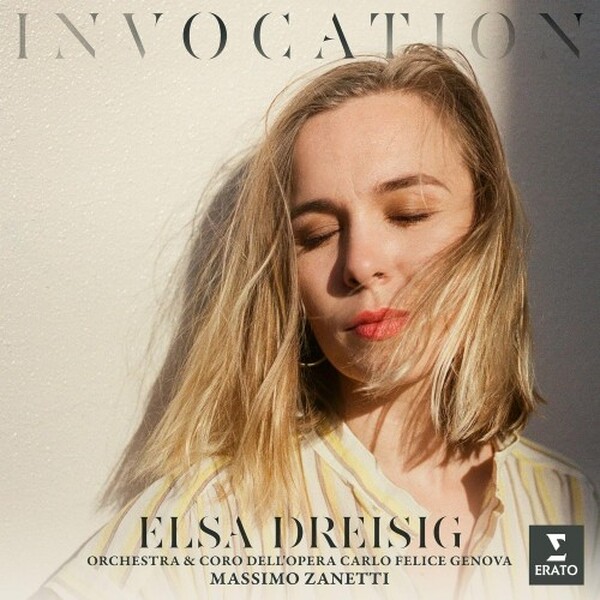
Elsa Dreisig: Invocation
£15.15 £14.20
save £0.95 (6%)
special offer ending 28/02/2026
Despatch Information
This despatch estimate is based on information from both our own stock and the UK supplier's stock.
If ordering multiple items, we will aim to send everything together so the longest despatch estimate will apply to the complete order.
If you would rather receive certain items more quickly, please place them on a separate order.
If any unexpected delays occur, we will keep you informed of progress via email and not allow other items on the order to be held up.
If you would prefer to receive everything together regardless of any delay, please let us know via email.
Pre-orders will be despatched as close as possible to the release date.
Label: Erato
Cat No: 2685409371
Format: CD
Number of Discs: 1
Genre: Vocal/Choral
Expected Release Date: 23rd January 2026
Contents
Works
Songs (3), op.21Artists
Elsa Dreisig (soprano)Teatro Carlo Felice di Genova Choir
Teatro Carlo Felice di Genova Orchestra
Conductor
Massimo ZanettiWorks
Songs (3), op.21Artists
Elsa Dreisig (soprano)Teatro Carlo Felice di Genova Choir
Teatro Carlo Felice di Genova Orchestra
Conductor
Massimo ZanettiAbout
One of the “greatest hits” is “Casta Diva”, the heroine of Norma’s reflective prayer to the moon goddess. Elsa Dreisig feels that it forms the heart of the album, which she describes as full of moments when “an operatic character communes with herself and where her soul sings”. As she says: “These invocations bring together two dimensions. On one side there is intimacy and vulnerability, giving rise to particular vocal colours … On the other, an appeal to a supernatural power, which lends a unique dramatic intensity to the moment. It is this fusion of intimacy and drama that means the most to me … There is not just one voice or vocal colour for a role, but rather an infinite range of nuances, like so many human emotions.”
The silvery gleam in Elsa Dreisig’s timbre is apt for another famous “lunar” aria, the wistful “Song to the Moon” from Dvořák’s Rusalka, but earthier tones emerge in two Puccini arias: “Vissi d’arte”, the despairing Tosca’s appeal to God, and, from Gianni Schicchi, “O mio babbino caro”, young Lauretta’s irresistible plea to her father. It so happens that Lauretta is the only operatic role represented on Invocation that, as yet, Elsa Dreisig has sung on stage. Among the other characters she portrays on the album are Verdi’s Desdemona (Otello) and Leonora (La forza del destino), Wagner’s Elisabeth (Tannhäuser), Janáček’s Jenůfa, and even a heroine whose aria “Ô ma lyre immortelle” is known as an imposing showpiece for mezzo-sopranos. It comes from Gounod’s Sapho, an opera that is rarely performed – though more familiar to the world than three other works that contribute to Invocation: the operas Anna di Resburgo by Carolina Uccelli (1810-1858) and Drot og Marsk (King and Marshal) by Peter Heise (1830-1879), and the cantata Clovis et Clotilde, with which the 18-year-old Georges Bizet won the Prix de Rome in 1857.
Carolina Uccelli was born in Florence and her talents as a composer were recognised by Rossini (whose opera Le Siège de Corinthe also features on Invocation); he praised her “expressiveness and elegance in declamation and melody”. Uccelli’s Anna di Resburgo (her second opera, composed to a libretto previously set by Meyerbeer) was premiered in Naples in 1832. It was revived nearly two centuries later, in 2024, by the American company Teatro Nuovo. The New Yorker’s Alex Ross judged that the opera gave “the impression of a wide-ranging musical mind that possesses historical consciousness and experimental intelligence in equal measure”. Peter Heise was born in Copenhagen – his presence on Invocation acknowledges Elsa Dreisig’s connection to Denmark through her mother, the soprano Inge Dreisig, who moved to France to study at the Paris Conservatoire. Heise is admired for the many songs he composed, and Drot og Marsk, a tragedy set in the Middle Ages, stands as the most important Danish opera of the 19th century. Scandinavia is also the source for Solveig’s haunting song from Grieg’s music for Ibsen’s play Peer Gynt, while a paean to nature by the great French writer Victor Hugo gave rise to “Extase” by the American composer Amy Beach (1867-1944), whose reputation has grown considerably in recent years.
Error on this page? Let us know here
Need more information on this product? Click here